Wednesday, May 22, 2024

Outdoor Math: Representing numbers

We used sidewalk chalk to create number lines counting back from 20.

We added a shape review to our number lines.

This is an outdoor version of bears in a cave.  We call it splat.  We put 10 of something (circle in this case) in the middle of our group.  1 child hides from the group and another child picks up and sits on a certain number of circles.

When the hidden child returns they have to figure out how many circles are missing based on how many they can see.
Using white boards outside to represent numbers in different ways.


Tuesday, April 30, 2024

Popcorn Popping on the Apple Tree!

 I looked out the window and what did I see?

Popcorn Popping on the apple tree!

Spring had brought me a nice surprise.

Blossoms popping before my eyes!

I could take an armful and make a treat!

A popcorn ball that would small so sweet!

It wasn't really so but it seemed to be,

Popcorn popping on the apple tree!

-Georgia Bello


This is a fun craft to do during the spring time when the trees are blossoming.  We draw a tree branch on a small sheet of paper, add a few green cut out leaves.  The blossoms are popped popcorn!  I color them with powdered tempra paint to make them pink but would just as well left white.

I enjoyed created this display and the kids enjoy walking under our apple tree as we go in and out of the classroom.


Wednesday, April 24, 2024

Moments of joy.

Teaching is amazing and it has become increasingly complex.  There is an abundance of initiatives and new directions.  It can all be very overwhelming.  I added a section of my plan book this year to write down 1 joy moment of each day.  I revisit those moments when I need a pick me up.  This handful of dandelions, presented to me after one recess is reminder of the joy of working with little kids.  I hope this makes you smile today.


Monday, March 25, 2024

Animal Tracks (in the snow)


Snow fall is great for learning about the animals that live in our school habitat and the stories their tracks tell.   We don't often see live animals because we are noisy and constantly on the move but the tracks left behind tell us a lot about who lives in our school habitat.

We start by learning about the different shapes of tracks and how to read the direction they lead and show what the animals were up to. 

We received these fabric track bandanas from the Jeffers Institute.  They have a field guide around the edge and a story in tracks in the middle. We use these before we go outside to learn how to read the scene.

We we do go outside to find tracks we talk a lot about where to step and how to preserve tracks.  It is amazing how many different tracks the kids find and how many exotic animals the kids believe have passed through out school forest.  We keep field guides on hand and journal about our finding.

Thursday, March 21, 2024

Outdoor Poetry

As part of our literacy and language arts I like to take observational style poems outdoors.  I write them on sturdy pieces of cardboard.  As we observe the weather or seasonal changes we generate ideas about how to complete the sentence frames in each poem.
This is a great way to use sight words and to introduce new vocabulary and the concept of describing words.


Wednesday, March 20, 2024

Tracking Temperture

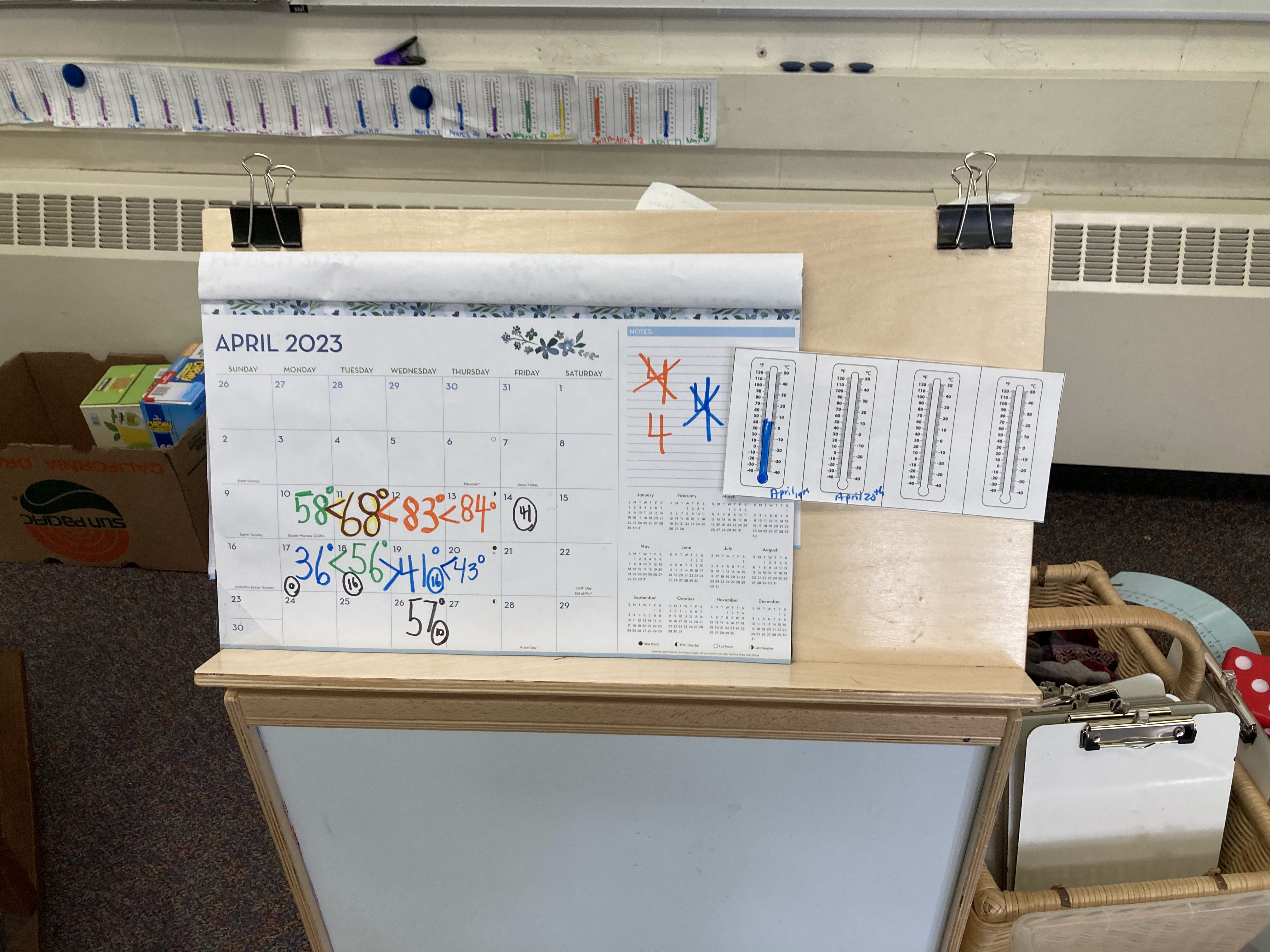
One of the ways I meet math and science standards it to track and compare daily temperatures.  I ask for donations of standard wall calendars so that each child has their own.  Each day we track and compare the temperature.  As we get better at writing numbers we include how many days we've been in school and how many eggs we collect that day.

Another way to track temperature is by filling out a small thermometer and making a thermometer line
like to a number line but with temperature..
This is a picture of my classroom thermometer.  We use the colors to help us determine how to dress for outside time.


Monday, March 18, 2024

Community and Campfire Days

A dream of mine has been to increase opportunities for families to join their child's Kindergarten day and provide meaningful outdoor learning.  I came up the Community and Campfire days!  The idea is to set aside a 2 hour portion of 1 day a month when families can join their kindergarten participating in outdoor stations.  The stations include community volunteers and activities that are outdoors, actively engaging and meet standards.


The Structures: Kindergarten divides into 6 small groups of 10-15 students per group.  Each group rotates through each station for 20 minutes.  Each group is accompanied by a classroom teacher or para who assists with the activities and helps with group management.


The Stations:

The goal is for each station to be hosted by a community volunteer from the school, district or greater community.  Volunteers will arrive 15 minutes before the start of the station to set up and 15 minutes to clean up. We typically have a story stroll, a campfire and fruit or veggies roasting station, an outdoor math game, meet an animal, do a related craft or project, and learn from a community member volunteer.


I partnered with our local library system. A children's librarian joins us and reads a story stroll with each group (which she brings and sets up!)


I partnered with our Nutrition department and they are enthusiastic supporters of our program! They were able to use grant funds to buy all our roasting fruits and vegetables (Science, Health, Nutrition) Students learn where the food is grown (map and geography connection) and how it benefits their health and bodies. Then they roast the fruit or vegetable over the campfire (managed by parent volunteers) and taste it.  They graph their experiences.  All leftovers are composted!  Zero waste is the goal.


Playing an outdoor math game.

Our local public librarian sharing a story stroll.

One of our amazing nutrition staff teaching about the beets we would be roasting !  She was able to use funds from the fresh fruits and vegetables grant to supply our foods for roasting!  Our school nutrition staff are very supportive and prepare the foods for us (including pre-baking some of the harder vegetables and fruits so they roast more quickly)

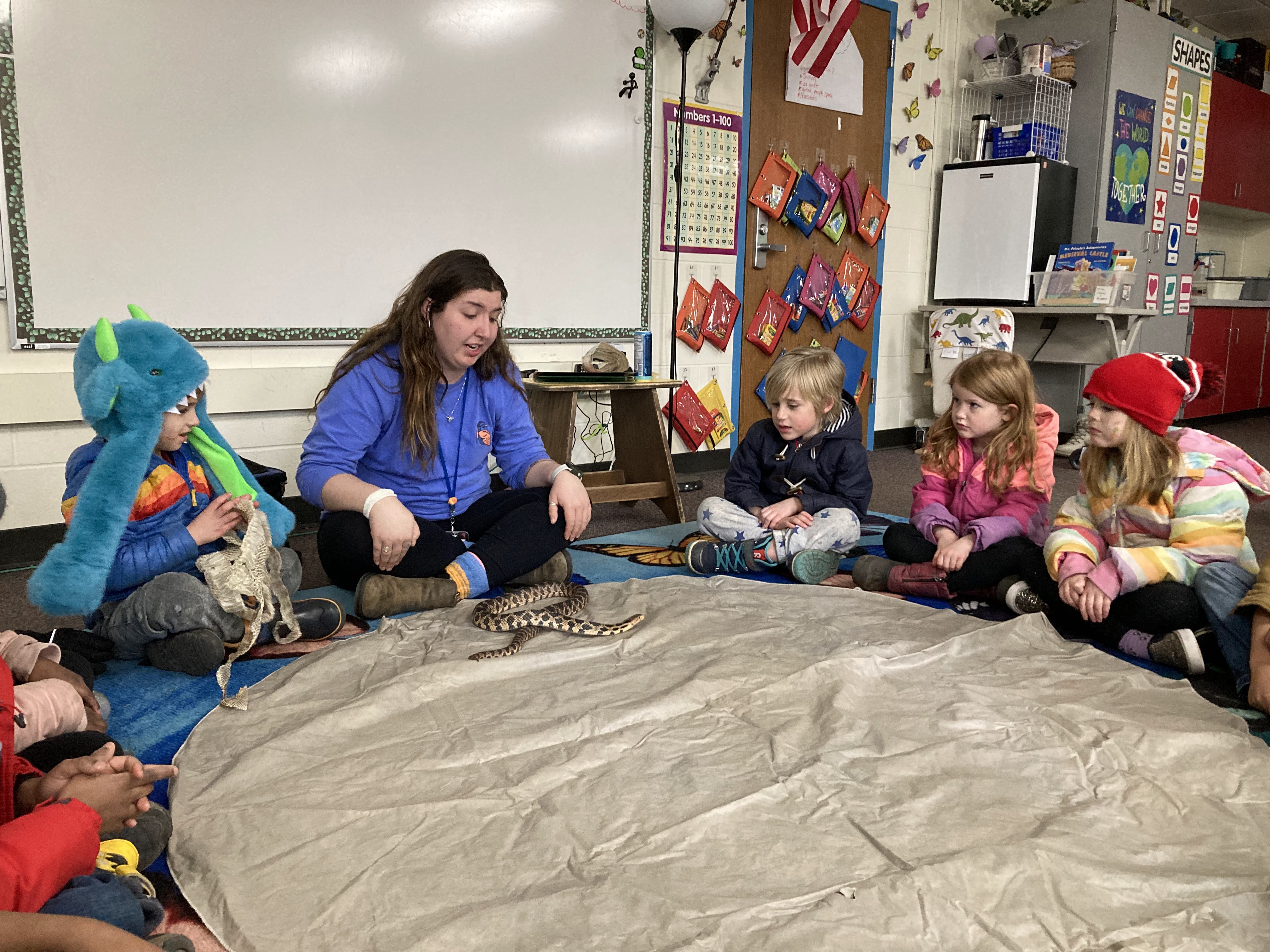
One of our school paraprofessionals has a connection to a local nature center.  She brings in animals from the nature center and teaches about them.  Here we are meeting the world's nicest snake!

Lots of grown ups volunteer to help with the campfire.  We do have a permit.  Be sure you know the fire rules in your local area and pre-teach fire safety.

Enjoying a fun and sensory nature craft but together by an amazing parent volunteer.


Saturday, March 16, 2024

The story of our year

April
I visited a Reggio inspired preschool for a professional development program and I became inspired by the photo stories that were on display sharing their inquiry process through photos, short, descriptive sentences and student quotes.  This year the kids and I created monthly posters titled "We Saw".  I printed photos of some of the events of the month and the kids helped with the captions.  Here are the month by month "stories of our year".


Sunday, May 7, 2023

Goats and Chickens!

Our school is very lucky to have therapy goats and chickens on campus.  Our Kindergarten class has recently taken on the task of the main egg collectors and distributors.  This has led to opportunities for math, data collection and animal interactions as well as inquiry into which treats the animals like the best and questions about the life cycle of a chicken.  Note, we do not have any roosters, therefore our eggs will not hatch.

Our two therapy goats, Cinnamon and Sugar, vying for a treat of carrots from the Kinders.

This is first time a chicken allowed me to pick her up and allowed the children to pet her!


After gathering we count the eggs and write the total on our calendar.  We also note the number of each color of egg collected that day.

We use the egg carton as a 12 frame to show the collected number a different way.

Checking the coop.  Note, this is an unusually large number of eggs!

Sunday, April 23, 2023

Hopes and Dreams on Display

One of the ways I like to connect with families is to ask parents, at the beginning of the year or during parent/teacher conferences, to write their hope and dream for their child (for their Kindergarten experience).  This are displayed in the form of a chandelier.  Each child chooses and adds a peace bead to the chandelier.  In the future I plan to add the student's hopes and dreams to a ribbon also.  Here are the creations we've made so far.


This is the chandelier in progress at open house night.  This one uses a quilting hoop as the base or anchor.


The ribbons are attached to a piece of cactus wood I was given.


Saturday, April 22, 2023

Making rain/ Learning about the water cycle

This is a great activity to try during a weather unit. You need 2 liter soda bottles (or another type of plastic bottle). Cut the bottle in half. Put about and inch of warm water in the bottom of the bottle. It helps to color it blue (for the ocean). Invert the top half into the bottom half (with the cap on). Fill the top with ice. After a few minutes clouds will form and droplets of "rain" will form on the inverted top. It's raining!

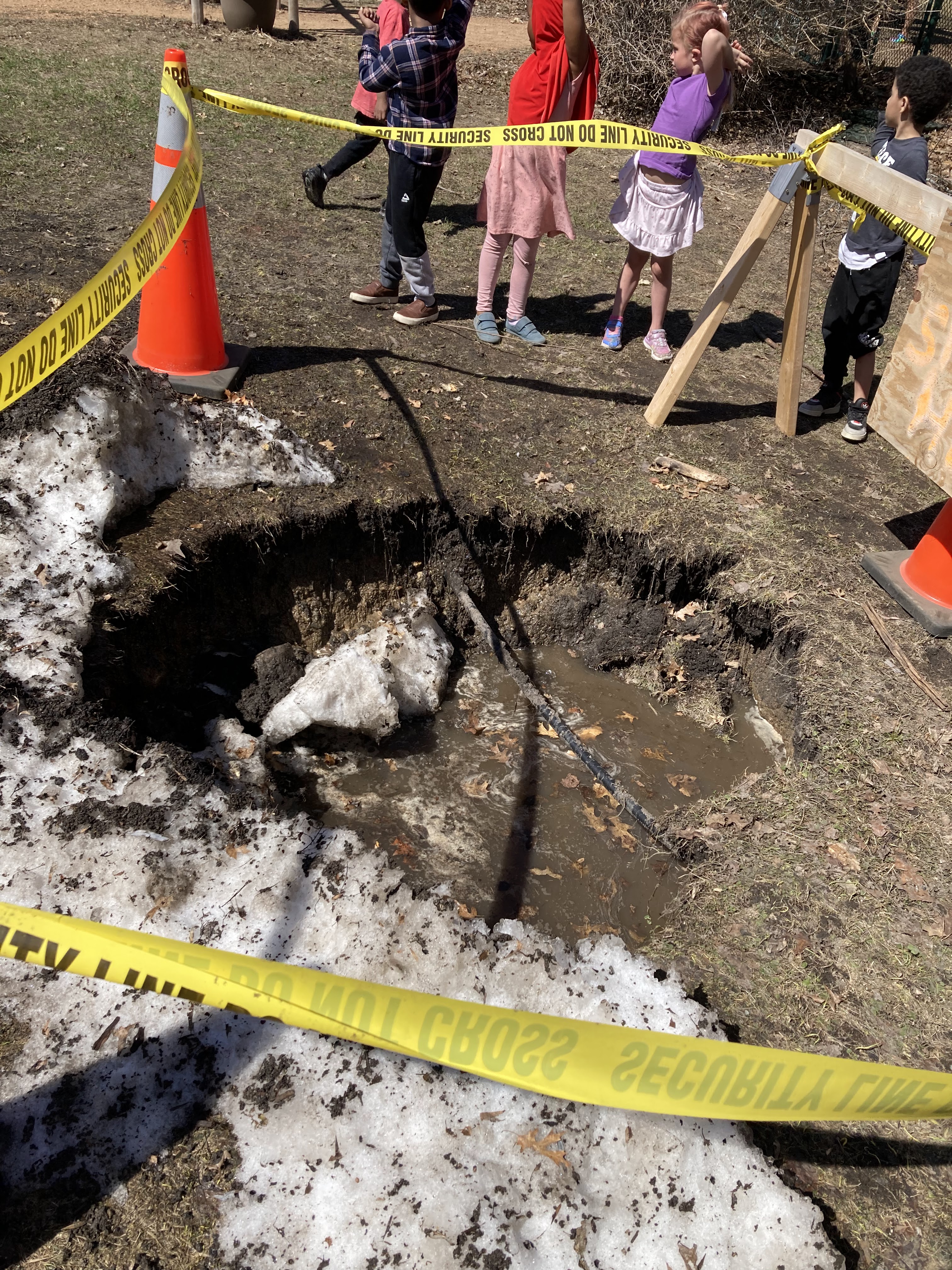
I had to update this post as we have done so much more around the water cycle and weather since the original project in 2010.  Weather has been added to our standards and our outdoor program affords us all kinds of opportunities to explore the power of water!  This year (2023) we had a week of extremely warm weather following an extremely snowy winter!  Our Mount Snowmungeous melted so quickly we actually had a sink hole on our campus!  The following is our water story.  One of our K teachers  taught us this song about the water cycle 

The Water Cycle
(Tune of O My Darlin Clementine)

Evaporation! (float fingers up from waist level like rising water vapor)
Condensation! (make cloud shapes with hands overhead)
Precipitation on my mind, (rain fingers down and point to head)
And it's called the water cycle (trace circle in the air in front of your body)
And it happens all the time.


This is another way to do the "making rain" experiment.  I like this one better because it takes less space, doesn't require ice and can be ongoing and used to collect data.


Mount Snowmungeous (a small section)


We visited the sink hole and talked about what we notice and what we wonder.


We used this simple video to learn more


A few days later these workers came and filled the hole and we were able to talk to them about what they were doing.  I think they got a kick out of teaching Kindergarten for a little bit!

Along with our learning about sink holes we also noticed the flowing water and did an inquiry about snow melt.  We followed the path of the water flowing from the snow melt, to the gutters and cracks in the parking lot pavement as it flowed into a drain that creates a small stream that flows into our school pond!

Checking the storm drains.  Are they full?


The water flows!  What can float?  What stops the water?  We reclaimed the work dam as a wall that blocks water.


Exploring the stream that flows to our school pond.  We are so lucky to have these resources on our school campus!  Rain boots are on our yearly supply list.