Showing posts with label Nature/outdoor learning. Show all posts

Monday, March 25, 2024

Animal Tracks (in the snow)


Snow fall is great for learning about the animals that live in our school habitat and the stories their tracks tell.   We don't often see live animals because we are noisy and constantly on the move but the tracks left behind tell us a lot about who lives in our school habitat.

We start by learning about the different shapes of tracks and how to read the direction they lead and show what the animals were up to. 

We received these fabric track bandanas from the Jeffers Institute.  They have a field guide around the edge and a story in tracks in the middle. We use these before we go outside to learn how to read the scene.

We we do go outside to find tracks we talk a lot about where to step and how to preserve tracks.  It is amazing how many different tracks the kids find and how many exotic animals the kids believe have passed through out school forest.  We keep field guides on hand and journal about our finding.

Monday, March 18, 2024

Community and Campfire Days

A dream of mine has been to increase opportunities for families to join their child's Kindergarten day and provide meaningful outdoor learning.  I came up the Community and Campfire days!  The idea is to set aside a 2 hour portion of 1 day a month when families can join their kindergarten participating in outdoor stations.  The stations include community volunteers and activities that are outdoors, actively engaging and meet standards.


The Structures: Kindergarten divides into 6 small groups of 10-15 students per group.  Each group rotates through each station for 20 minutes.  Each group is accompanied by a classroom teacher or para who assists with the activities and helps with group management.


The Stations:

The goal is for each station to be hosted by a community volunteer from the school, district or greater community.  Volunteers will arrive 15 minutes before the start of the station to set up and 15 minutes to clean up. We typically have a story stroll, a campfire and fruit or veggies roasting station, an outdoor math game, meet an animal, do a related craft or project, and learn from a community member volunteer.


I partnered with our local library system. A children's librarian joins us and reads a story stroll with each group (which she brings and sets up!)


I partnered with our Nutrition department and they are enthusiastic supporters of our program! They were able to use grant funds to buy all our roasting fruits and vegetables (Science, Health, Nutrition) Students learn where the food is grown (map and geography connection) and how it benefits their health and bodies. Then they roast the fruit or vegetable over the campfire (managed by parent volunteers) and taste it.  They graph their experiences.  All leftovers are composted!  Zero waste is the goal.


Playing an outdoor math game.

Our local public librarian sharing a story stroll.

One of our amazing nutrition staff teaching about the beets we would be roasting !  She was able to use funds from the fresh fruits and vegetables grant to supply our foods for roasting!  Our school nutrition staff are very supportive and prepare the foods for us (including pre-baking some of the harder vegetables and fruits so they roast more quickly)

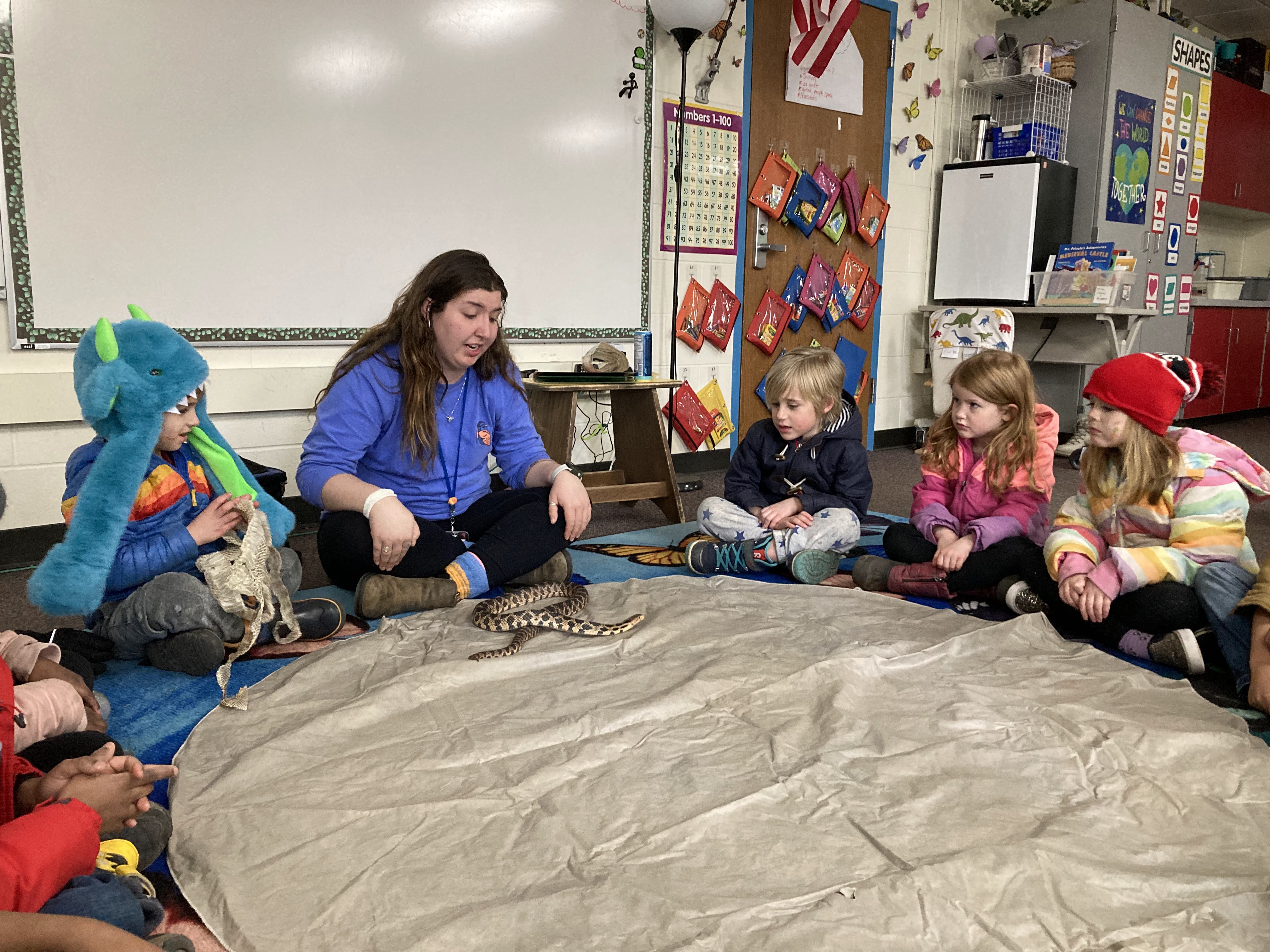
One of our school paraprofessionals has a connection to a local nature center.  She brings in animals from the nature center and teaches about them.  Here we are meeting the world's nicest snake!

Lots of grown ups volunteer to help with the campfire.  We do have a permit.  Be sure you know the fire rules in your local area and pre-teach fire safety.

Enjoying a fun and sensory nature craft but together by an amazing parent volunteer.


Sunday, May 7, 2023

Goats and Chickens!

Our school is very lucky to have therapy goats and chickens on campus.  Our Kindergarten class has recently taken on the task of the main egg collectors and distributors.  This has led to opportunities for math, data collection and animal interactions as well as inquiry into which treats the animals like the best and questions about the life cycle of a chicken.  Note, we do not have any roosters, therefore our eggs will not hatch.

Our two therapy goats, Cinnamon and Sugar, vying for a treat of carrots from the Kinders.

This is first time a chicken allowed me to pick her up and allowed the children to pet her!


After gathering we count the eggs and write the total on our calendar.  We also note the number of each color of egg collected that day.

We use the egg carton as a 12 frame to show the collected number a different way.

Checking the coop.  Note, this is an unusually large number of eggs!

Saturday, April 22, 2023

Making rain/ Learning about the water cycle

This is a great activity to try during a weather unit. You need 2 liter soda bottles (or another type of plastic bottle). Cut the bottle in half. Put about and inch of warm water in the bottom of the bottle. It helps to color it blue (for the ocean). Invert the top half into the bottom half (with the cap on). Fill the top with ice. After a few minutes clouds will form and droplets of "rain" will form on the inverted top. It's raining!

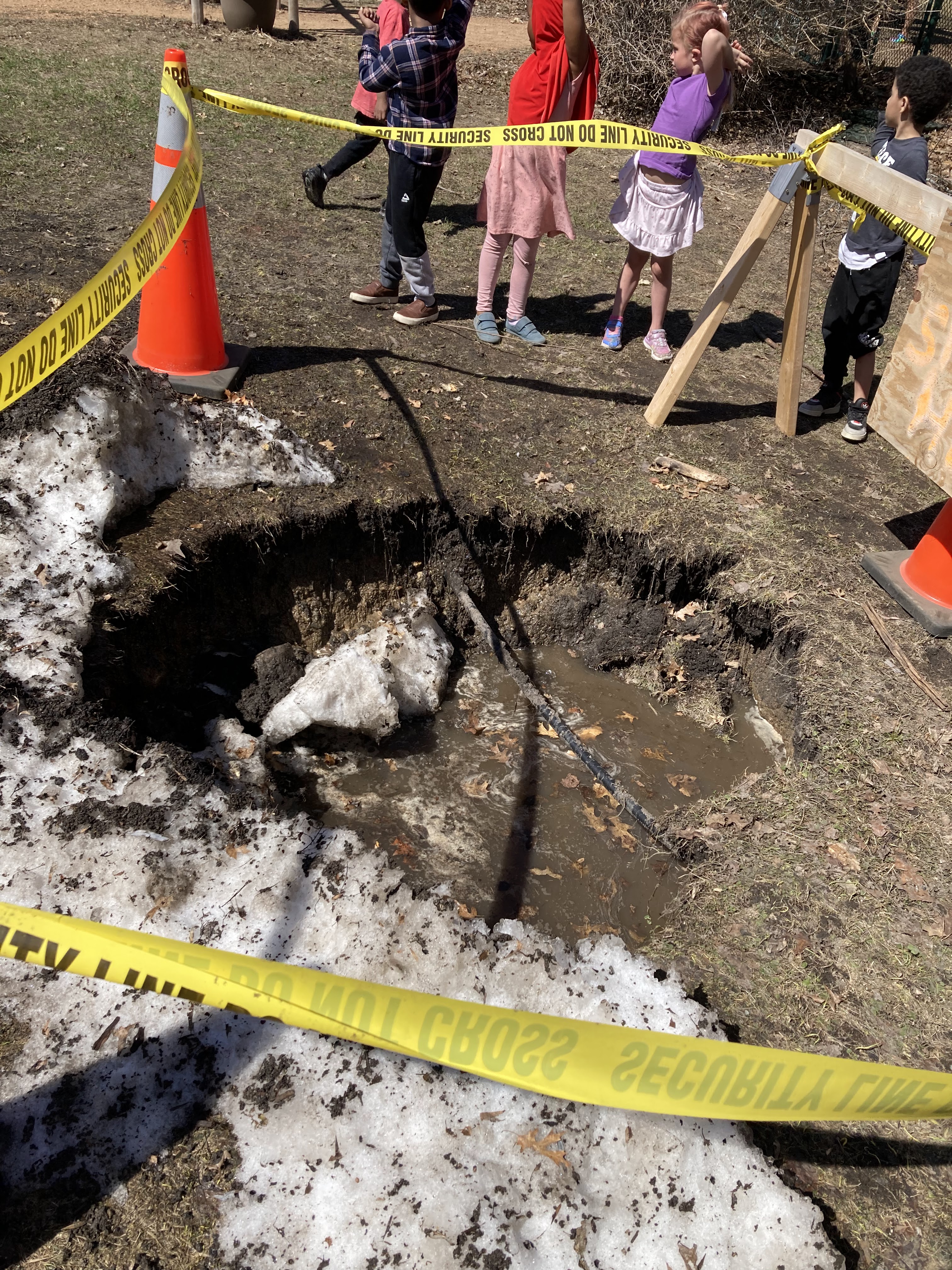
I had to update this post as we have done so much more around the water cycle and weather since the original project in 2010.  Weather has been added to our standards and our outdoor program affords us all kinds of opportunities to explore the power of water!  This year (2023) we had a week of extremely warm weather following an extremely snowy winter!  Our Mount Snowmungeous melted so quickly we actually had a sink hole on our campus!  The following is our water story.  One of our K teachers  taught us this song about the water cycle 

The Water Cycle
(Tune of O My Darlin Clementine)

Evaporation! (float fingers up from waist level like rising water vapor)
Condensation! (make cloud shapes with hands overhead)
Precipitation on my mind, (rain fingers down and point to head)
And it's called the water cycle (trace circle in the air in front of your body)
And it happens all the time.


This is another way to do the "making rain" experiment.  I like this one better because it takes less space, doesn't require ice and can be ongoing and used to collect data.


Mount Snowmungeous (a small section)


We visited the sink hole and talked about what we notice and what we wonder.


We used this simple video to learn more


A few days later these workers came and filled the hole and we were able to talk to them about what they were doing.  I think they got a kick out of teaching Kindergarten for a little bit!

Along with our learning about sink holes we also noticed the flowing water and did an inquiry about snow melt.  We followed the path of the water flowing from the snow melt, to the gutters and cracks in the parking lot pavement as it flowed into a drain that creates a small stream that flows into our school pond!

Checking the storm drains.  Are they full?


The water flows!  What can float?  What stops the water?  We reclaimed the work dam as a wall that blocks water.


Exploring the stream that flows to our school pond.  We are so lucky to have these resources on our school campus!  Rain boots are on our yearly supply list.

Friday, March 3, 2023

Making Felted Acorns

Felting/making felted acorns is one of my favorite fall crafts.  This is a great multi-sensory experience for little hands.  You will need a collection of clean acorn caps, felt, tubs for warm soapy water and hot glue guns for the adult helpers. 
Felting outside!

First, students select a thumb size amount of loose felt.  I like to use 2 or 3 different colors.  While dry, kids roll the felt into a loose ball.  Then they dip the felt into the warm water, squeeze out the water  and roll the felt into a tight ball.  They keep dipping, squeezing and rolling until the felt makes a tight dense ball.  Then the kids choose an acorn cap (previously collected and the teacher hot glues the cap onto the felt.  If desired the acorn can be glued to a magnet or a piece of yarn to create a necklace.


Proud of our creations.


I like to keep a collection for counting and other sensory activities.


Saturday, January 1, 2022

Pumpkin Explorations


The play button should take to you to a video of our school naturalist chopping open our giant pumpkin.
I hope technology is on our side!
 
A family donated a giant pumpkin!  We made a big rocker balance out of a log (fulcrum) and a sturdy board.  The kindergarteners were able to compare their weight with the giant pumpkin.  Only two kids were able to tip the scale!  Later, our naturalist chopped the pumpkin open.  We collected the seeds and watched it decompose in our learning forest.  

We invited families and other adults in our district community to lead small groups of kids in a pumpkin exploration day.  They counted seeds, explored pulp, weighted, measured and carved.  We provided observation sheets to record their findings.  Using this produce scale to weigh the pumpkins was a highlight.

Click on this link to watch the magic of baking soda, vinegar, and green food coloring as they interact with a carved pumpkin.
We kept one pumpkin indoors, enclosed in a plastic container and observed the decomposition process.
The book Pumpkin Jack by Will Hubbell is a great resource and read aloud for this.

We left some of our pumpkins outside to find out what would happen to them.


The happy dancing pumpkin helped us learn a pumpkin rhyme.


We asked families to donate gourds and pumpkins.  We collected enough variety to engage in hands on sorting, measuring and patterning activities.


More pumpkin physics!


Wednesday, July 28, 2021

The Jeffers Foundation-An excellent resource for Minnesota Educators

If you are a Teacher in Minnesota please check out the website for the Jeffers Foundation.  They have a lot of wonderful resources that connect teachers and students with outdoor learning and nature. 

I was able to attend one of the three day Team Teaching with Mother Nature and it was engaging, fun and helpful.  I have more ideas and resources now for teaching outdoors.  Jeffers was also very generous.  The workshop was free, they provided lunch each day and they loaded me up with resources!  Please check out this hidden gem!  If you don't teach in Minnesota there are many resources on the Jeffers website that you can use for free!  Enjoy!
Using my new cloud and sky viewers that I made at the Jeffers workshop.  Made from upcycled cardboard, paint chip samples and cloud cut outs from and old calendar!


Wednesday, May 26, 2021

Pajarito- Connecting indoor and outdoor learning

I have a bird feeder outside my classroom window with a basic common bird field guide.  One of the most common visitors are Chickadees.  They will even stand at the top of the feeder and peek in at us when there are no seeds in the feeder.

I love the imagination of young learners.  They believe that animals can talk and even write letters.  This is where Pajarito comes in.  He is a Chickadee who lives around our school and is able to hear what we are learning in our class by using a magic birdhouse.  

He writes us weekly letters and delivers them to a special mailbox.  When the flag is up the kid know there is a new letter, and sometimes a book. 

Pajarito gives us the inside scoop on what to look for when we are on our nature adventures.


Monday, May 24, 2021

Rock Collection activities

Identify the rocks we've collected and make our own field guide of rocks by drawing and labeling our rocks.

Look closer with magnifying glasses and our digital microscope.

Weigh and measure our rocks.

Scrub off our rocks and look for hidden surprises!


Friday, May 21, 2021

Rock collections

It is so interesting to watch kids collect rocks.  Some are very choosy and only the prettiest or most interesting make it into the collection.  Others fill their pockets or containers, believing quantity makes the best collections.

When a special rock is found, they can't wait to show someone, sharing the beauty they discovered.

Each child has a favorite rock, and each of the favorites is unique.

Egg cartons make excellent rock collection boxes.

Sometimes bits and pieces of questionable materials make it into the collection.  The inquiry becomes "is this a rock?" Can any beautiful bit be part of the collection?