Tuesday, March 30, 2021

Not a Stick! Explorations with sticks in nature

One of the most abundant natural resources on our school grounds is the ever versatile stick.
Oh the shapes!  Oh the sizes!  Oh the possibilities.  I find that children have varied experiences with sticks.  Some have been taught that sticks are dangerous and should not be handled, others go straight to sword fighting.  Using sticks as a source of imaginative exploration and using sticks as tools are important parts of being a nature kid.  However, being responsible for kids that have different levels of spacial awareness does require teaching and a class meeting about safety.  I like to start with Not A Stick by Antoinette Portis.  This give the kids a bunch of ideas about what a stick could be.

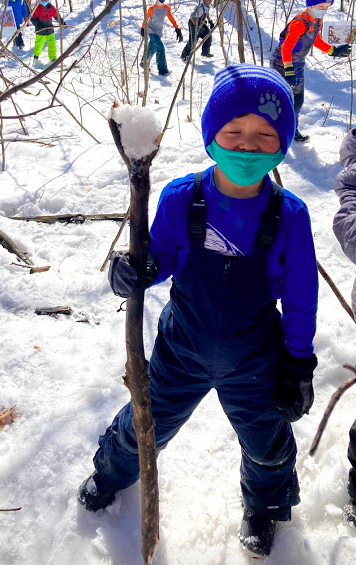
Next we talk about and practice how to look around us and make sure there is no one in the "zone of possible accidents" that could be hurt if we swing the stick.  As the teacher, you will need to decide if stick sword fighting is allowed and how you feel about sticks being used as pretend guns.  I have seen sticks used in wonderfully creative ways like: fort building, walking sticks, fishing poles, magic wands, wizards staffs, skis and so much more.  Using sticks also helps students notice details.  Stick explorations led one child to discover different types of bark on the ground and explore the sounds the barks make when shaken.
Sticks can even be used to create letters and kid can be challenged to make their name with sticks.  Sticks are free, compostable and abundant.  They make excellent learning materials.  What's brown and sticky?  A stick!
 

Sunday, March 28, 2021

Story Strolls and Heavy Work


 This post is meant to be about story strolls or book pages that  follow a path through our "Northwoods" learning forest.  First, however, can I address the kids in this photo and how proud they are to be able to work as a team and carry that big, heavy branch up and down the trail (and, for some reason, chanting "We are going to be famous!")? It must feel so good to their bodies to carry something heavy.  Angela Hanscom writes about the physical benefits of nature play in her book Balanced and Barefoot.  I can personally recommend this book.  It is eye opening and fully supports getting kids outside.

Now back to story strolls (pictured in the left hand corner and middle left side).  The one show is much more sophisticated than my personal connection, which consists of books, taken apart and put in clear baggies, or plastic sleeves or laminated (before I gave up laminating after learning about the environmental devastation of plastic.  Confessions of a former laminator junkie could be its own post). I put a loop of yarn through each page and hang them from trees to form a simple story stroll. 

The strolls in this picture are actually on loan from out public library system.  I highly recommend reaching out to your library and finding out if these exist in your area.  The book pages are laminated and attached with Velcro to a foam core "campaign" style yard sign.  The signs are attached to a metal stand and can be easily moved around to create a customized path/stroll.  These are a great way to get kids reading outside.  We invite the entire school to enjoy these.  It warms my heart to see the older kids engaged in reading these engaging picture books outside.  I am able to change out our story strolls twice a month.

It has been a while. Tea?


 Where have I been?  My last post was December 2016.  May of 2017 I found out that my position had been cut and I was moved to first grade in a different school in my district.  I both, needed the change and became buried in the task of learning a new grade level, a new team, a new school and a dizzying array of new web formats.   I forgot about my blog and, if I'm honest, I didn't feel like I had anything worth sharing anyway.  I was able to complete an accelerated master's program (Curriculum and Instruction with a concentration in Environmental Education).   Then COVID threw us all on a giant rollercoaster ride.  By the end of each screen filled day, my eyes were so tired and my body sore from sitting that any extra computer time was painful to consider.  Now I am at a crossroads again.  Like many school districts, mine is facing major funding cuts.  I don't know what I will be teaching next year, maybe first grade, maybe Kindergarten, possibly a combination of 1st and 2nd grade.  I do know this, I am weary of trying to "get through" the curriculum and failing.  I know that kids will focus and spend far more time and energy learning about a subject of their choosing, rather than following my/the districts/the curriculum's agenda.  I have seen the power of taking kids outside and letting them explore, question and discover.  I also teach in a community next door to Minneapolis Minnesota.  The issues of racism are very real and I am trying to be antiracist and learning how to have authentic discussions with my students about embracing our differences and caring about each other.  So begins another journey.  This spring I am stepping into the unknown and planning an outdoor immersion, inquiry unit.  I hope I can learn enough to teach this way going forward.  Thank you to Mrs. Meyers at Inquiring Minds .  You reminded me that I have a blog and blogs are a great way to share what we do.  Thank you for introducing me to inquiry with young children.  Thank you for reading this!  Please share with me how you are and what you find that sparks joy in teaching for you!

Tuesday, December 20, 2016

Snowpal Kits

Each year, before winter break I like to give my students a small gift, usually something to do away from school.  This year I couldn't find the right thing to buy but after digging through my arts and crafts supplies I came up with snowpal kits!  I cut snowpal shapes out of compressed felt and used fabric scraps to cut out 2 different shaped hats and scarves, added different buttons, pasta pieces, etc and put all the pieces in a baggie with a little poem I wrote.  Viola!  A fun and somewhat simple gift with things I had on hand!
Snowpal Kit ready to go home with kids.
This year, due to COVID numbers I didn't send the kids home for a winter break activity.  Instead we used them to retell the story of There Was A Cold Lady Who Swallowed Some Snow by Luicille Colandro.  I stapled envelopes with all the snowpal pieces in the back of a copy of the book and was able to give each student their own copy.
Here is a completed snowpal.
Checking the book to find out what part goes next!

Making snowpals is thirsty work!


Friday, January 29, 2016

Word family games for -ice and -ed

Here is a fun way to help kids create -ice word family word.  I wrote -ice on an ice scraper and the kids change the beginning sound to make a new word and then write that word.  I used jumbo magnetic letters.

Here is a fun way to help kids create -ed word family word.  I wrote -ed on an small wooden sled and the kids change the beginning sound to make a new word and then write that word.  I used jumbo magnetic letters.

Saturday, October 24, 2015

Story telling

Another piece of the Waldorf process that I am learning about and trying to incorporate is story telling.  I differentiate this from reading stories aloud by the element of pictures.  Story telling encourages the children to see the story using his/her imagination.  I am using this book Tell Me A Story which is a compilation of stories made up by Waldorf teachers.  The stories deal with nature and character development.  They are short and easy to read.  I read 1 each day during the transition from recess back into the classroom.  The read aloud encourages the kids to quiet down, drink water and take a brief rest.  I was able to purchase the book on Amazon but could not find a copy in the library.
I don't spend a lot of time talking about the morals but simply let the students absorb them as they are able.  The morals are not always obvious but subtly encourage kindness and helpfulness.

Sunday, October 4, 2015

Discovering Waldorf

 I teach in a traditional public school.  This year I had a really hard time getting into the groove of the new school year, particularly in the area if discipline.  I know that the only thing I can control is what I think, say and do.  So I began some soul searching about how to change my approach and my attitude.  One of the my team members shared that she is currently taking training to become a Waldorf teacher.  She shared with our team some of the philosophies of Waldorf and how school is viewed and run.  I was intrigued and began to research discipline strategies.
I can recommend the following site: The Magic Onions particularly this article: Waldorf Discipline 

One of the strategies is to have kids work on small motor activities to help them stay focused or return to calm.  I began collecting baskets, with handles and filling them with sea shells, rocks, glass stones, pine cones and other small, natural objects but one thing I kept reading about but had never seen was moldable beeswax.  I can be found on Amazon with varying review but I ordered it and found it to be a fantastic tool!
It comes in a small box like this with 15 wax blocks in different colors.

I used a scissors to cut several of the blocks into thirds and stored the rest.  I wanted to see how this would go.
I keep them in a container and kids may choose 1 piece to use at a time.
I found the wax to be a great small motor tool.  Kids have to warm it up in their hands for a few minutes before it becomes pliable.  Once it does it can easily be molded.  I doesn't crumble or mold like play dough, it smalls nice and has a nice texture.  It helps teach patience because of the need for it to warm up and is great for small motor.  It leaves no residue and to clean up kids simply put their piece back into the container.  It is safe, non toxic and won't harm kids even if they are orally fixated and try to eat it.  

I use all my small tools for transitions between activities, particularly for early finishers, and for kids that need extra small motor support.  Also, if a child is starting to become upset or argumentative I can bring him/her over to a table as give him/her a small motor task to do.

Another use is to use the wax or even other small objects as fidgets during listening time.  My rule is that a student has to get a fidget before we sit on the carpet and the fidget cannot leave the hands. This has helped a lot with "keeping has to self" during more concentrated listening time.